
Ed Seykota Trading Rules: A Risk-First Trend Following Reading
Search for Ed Seykota trading rules and you will find the same short list repeated on dozens of sites: cut losses, ride winners, keep bets small, follow the rules, know when to break them. The list is easy to memorize and hard to live by. This article does not just repeat it. It reads the best-known Seykota rules through a risk-first trend following method, the one we use at Trend Following Traders, and says plainly which parts of the story we could verify and which we could not.
It is educational material, not advice. Nothing here promises a result: trend following means many small losses, and backtests or past results guarantee nothing about the future.
Who is Ed Seykota, and where do the rules come from?
According to Wikipedia, Edward Arthur Seykota was born on 7 August 1946 and earned degrees in electrical engineering and in management at MIT in 1969. Together with Michael Marcus he worked at a brokerage house, where he developed a computerized futures trading system. He had been inspired by a letter from Richard Donchian on mechanical trend following systems, and his first system was built on exponential moving averages, later refined with extra rules, pattern triggers and money management algorithms. Jack Schwager gave him a chapter in Market Wizards, which is how most readers first met him.
Here is the caveat that most “Seykota rules” articles skip. The famous list of five rules circulates widely, but the sites repeating it rarely cite a primary source, and their wording differs from one page to the next. Seykota’s own site, seykota.com, is mostly a collection of FAQs, models and the Trading Tribe material; we did not find the list there in that form. So treat the five rules below as the commonly attributed summary of his teaching, not as a verified quotation. What is solidly documented is the method behind them: objective, testable, trend-following rules, applied with discipline.
What are the Ed Seykota trading rules?
The usual summary reads: cut losses, ride winners, keep bets small, follow the rules without question, and know when to break the rules. Add a sixth that Seykota is known for in the Trading Tribe material: your emotions are part of the system. Read one by one, they look like folk wisdom. Read together, they describe a risk-first method, because each rule is really about what you are allowed to lose, and when.
Rule 1 and 2: cut losses and ride winners
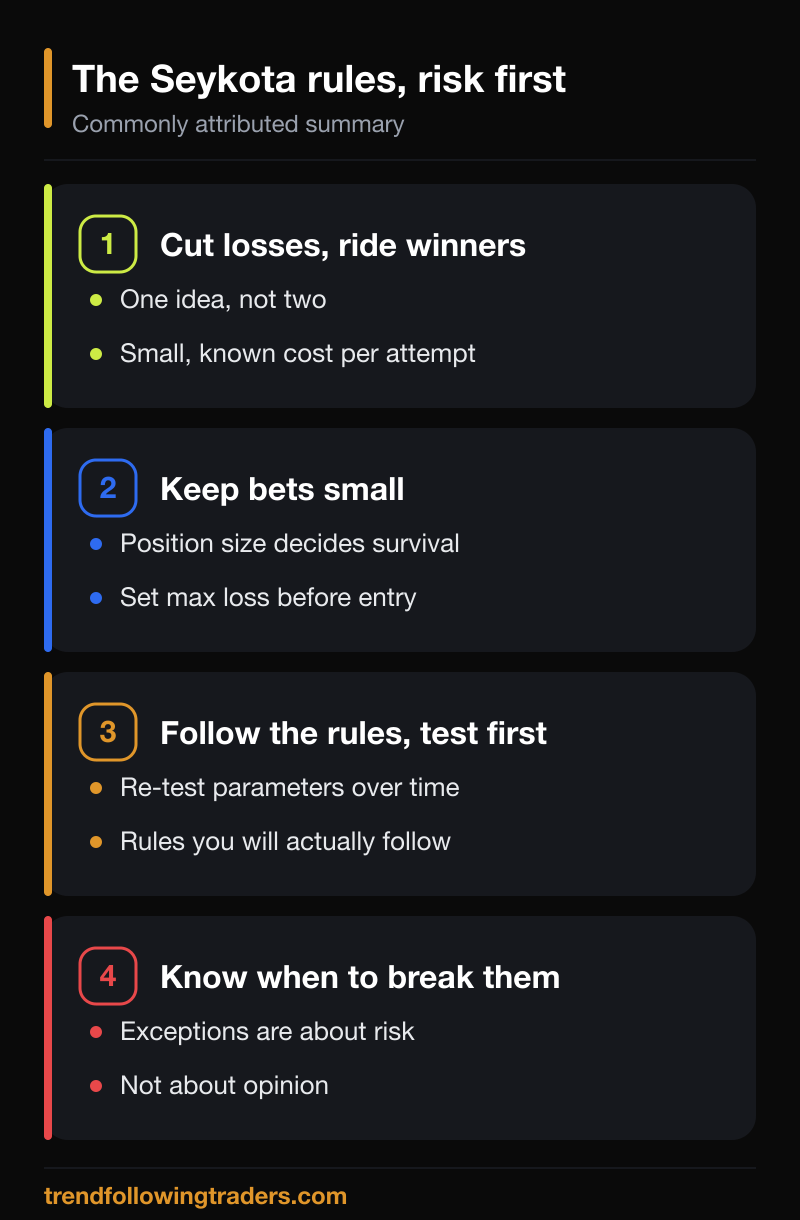 These two are one idea, not two. A trend follower does not know which attempt will turn into a big trend, so the only variable he controls is what each attempt costs. Cut losses, and the cost is small and known in advance. Ride winners, and the occasional strong trend pays for many failed tries. This is exactly the asymmetry we describe in risk reward in trend following: spend little on each attempt, keep the stop tight and defined at entry, and let the market decide how far a winner goes.
The honest flip side is that the price of this profile is a lot of small losses, whipsaws, in sideways markets. The cure is not a cleverer entry. It is accepting that the method pays unevenly: you give up frequent wins in exchange for rare large ones. Anyone selling the first half of this rule without the second is selling something else.
Rule 3: keep bets small
If we had to pick the rule that matters most for survival, it would be this one. Position size is the lever that turns a string of normal small losses into either an annoyance or a blown account. A risk-first method decides the maximum loss per trade, and the maximum loss in a month, before looking for a single entry. In our own research the risk per trade and a monthly drawdown limit are inputs we test, not afterthoughts, and the figures we study are always backtest settings, not promises.
Be careful with any article that gives you a magic percentage “from Seykota”. Numbers such as a fixed percent of the account per trade are repeated online without a primary source we could open, and the right size depends on the market, the stop width, how many positions can lose together and what you can psychologically bear. Use published figures as a starting point to test, never as a rule to copy.
Rule 4: follow the rules without question, but test them first
“Follow the rules” only makes sense if the rules were worth following. Seykota’s contribution was to test mechanical trend following rules on a computer in 1970, when that was unusual, and to keep the ones that held up. Our Italian write-up of his interviews with Michael Covel (the show notes of episode 355 on Trend Following Radio are one entry point) adds two ideas we find useful. First, a rule that worked in one era can stop working: parameters need to be re-tested because the character of markets changes. Second, a system is not only the maths. It is the maths plus your willingness to follow it, so a system you will abandon in a drawdown is a bad system, however good the backtest looks. (Those interview points come from our own summary of the audio; the show-notes page has no transcript, so we paraphrase and do not quote them.)
This is also why we are wary of over-optimization. A parameter set tuned to the past works perfectly for an imaginary robot that never doubts. Real traders do, so robustness matters more than the best-looking curve.
Rule 5: know when to break the rules
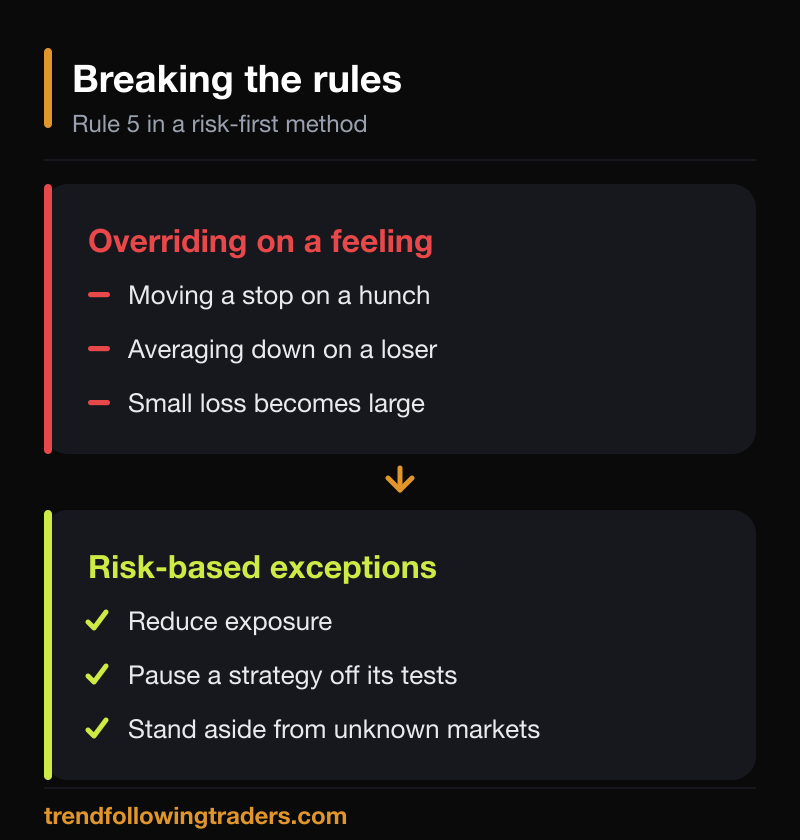 This is the rule most easily misread. It is not a licence to override a system whenever you feel nervous. In a risk-first method the legitimate exceptions are about risk, not about opinion: reducing exposure, pausing a strategy that has left its tested behaviour, or standing aside when a market is outside what you studied. Overriding a stop because you “feel” the market will turn is the opposite, and it is the classic way a small loss becomes a large one. Averaging down, adding to a loser in the hope of being proven right, is a bet that you cannot afford to lose even once.
Emotions: why a system does not remove them
Seykota’s best-known non-technical contribution is the Trading Tribe. Wikipedia reports that in 1992 he gathered traders to discuss how emotions override logic; the groups grew into Tribes worldwide and he described the approach in the book The Trading Tribe (2005). In the Covel interviews, as we summarised them, his point is that adopting a system does not make emotions disappear: it moves them up a level, from single trades to the whole portfolio. We would add the practical consequence from our side: that is why automation and predefined risk limits help. They do not remove feelings, they remove the moment of decision from the worst part of the drawdown.
How we apply this: data first, risk first
At Trend Following Traders our founder Stefano Mastria has followed the same trend following philosophy since his first publications in 2009-2010: small controlled losses, profits left to run, no prediction. What changed is the toolset: automated strategies built with StrategyQuant and optimized with AI, tested on about 9.5 years of Darwinex data. For us the Seykota lesson translates into a few operating habits.
- Decide risk per trade and monthly drawdown limit before any entry rule.
- Let the data say what a market has actually done, rather than forecasting what it will do. We call this trading on reality; see directional and automated trading.
- Match the horizon to what you can live with: long-term trend following pays rarely and a lot, short-term pays more often and less (see short and long term trend following).
- Never chase the market in difficult phases: contain the cost, protect capital, wait for trends to return.
None of this makes us “Seykota”. We are one community applying a familiar family of ideas, and we do not claim his results or his insight. What we take from him is the order of priorities: risk, then method, then yourself.
What the Seykota rules do not tell you
Short lists hide the hard parts. They do not tell you how wide a stop should be, which markets to trade, how many positions can be open at once, or what to do after a long losing streak. They also create a survivorship effect: we read about the famous trader whose approach worked, not about the thousands who followed similar rules and did not. Any rule is a starting hypothesis, to be tested on data you trust, with costs and slippage included, and sized so that being wrong is survivable.
Frequently asked questions
What are Ed Seykota’s trading rules?
The commonly cited summary is: cut losses, ride winners, keep bets small, follow the rules without question, and know when to break them. The exact wording varies between sites and we could not trace it to a primary source, so use it as a summary of his approach, not as a verified quotation.
What was Ed Seykota’s trading system?
According to Wikipedia, his first system was a computerized trend following system based on exponential moving averages, later extended with more rules, pattern triggers and money management. His site also hosts a study project on simple systems, offered as study material.
Do the Ed Seykota trading rules guarantee profits?
No. Trend following loses often in sideways markets and any rule can stop working. Backtests describe the past and guarantee nothing, and trading carries a real risk of losing capital.
Which rule matters most?
For a risk-first method, keeping bets small, because position size decides whether normal losing streaks are survivable. The other rules only work if you are still in the game.
If you want the free material we use for this research, the eBooks and the community collect our work on risk, trend following and quantitative strategies.